Published on ZamaZincume.com | Sovereign Health | Reading time: approx. 12 minutes
| QUICK ANSWER: A Christian plant-based diet is a way of eating that centres on whole plant foods such as vegetables, fruits, legumes, and grains. It draws on Scripture’s earliest dietary instructions and the example of Daniel in the Old Testament. This way of eating honours God by caring for the body He created, reducing disease risk, and practising the stewardship He calls every believer to live out. |
Introduction: Faith and Food Are Not Separate
Many Christians separate their faith from what they eat. But the Bible does not do that.
From the Garden of Eden to the letters of Paul, Scripture has much to say about food. It talks about what nourishes the body. And it calls the body a temple. It speaks of self-control as a fruit of the Spirit.
So what happens when we bring those truths together with modern nutrition science? We get something powerful. We get a way of eating that is good for the body, good for the planet, and rooted in God’s Word.
This article explores the Christian plant-based diet. We will look at what Scripture says, what science shows, and how you can start living this way today.
1. What Does the Bible Say About Food?
The First Diet Was Plant-Based
In the beginning, God gave people plants to eat.
Genesis 1:29 says: “I give you every seed-bearing plant on the face of the whole earth and every tree that has fruit with seed in it. They will be yours for food” (NIV).
This is the very first diet described in the Bible. It is entirely plant-based. There is no meat in the Garden of Eden.
This is not a small detail. It tells us something important. God’s original design for human food included plants as the foundation.
Meat Came Later
Meat entered the human diet after Noah’s flood. Genesis 9:3 records God saying people may now eat animals. But even then, certain rules followed. Leviticus 11 gave detailed instructions on clean and unclean animals.
Many Bible scholars call the original plant-based diet the “Edenic diet.” It reflects God’s first intention for human nourishment.
The Mosaic Law and Food
The Old Testament law gave clear food guidelines. Many of these foods were whole and unprocessed. Grains, legumes, olives, figs, pomegranates, honey, and dates are all mentioned positively throughout Scripture.
Deuteronomy 8:8 lists the seven species of the Promised Land: wheat, barley, grapes, figs, pomegranates, olive oil, and honey. Every one of these is a plant food.
Jesus and Plant Foods
Jesus ate fish and bread. He turned water into wine. He fed thousands with loaves and fishes. The Gospels show that Jesus was not rigidly plant-based in the modern sense.
But notice what Jesus ate most often. Bread. Vegetables. Figs. Olives. Legumes. These were the everyday foods of the Mediterranean world in His time.
The point is not that Christians must be vegan. The point is that plant foods have always been at the centre of a biblical diet.
2. The Daniel Fast: A Biblical Blueprint
One of the most powerful examples of a plant-based diet in the Bible comes from the book of Daniel.
Daniel 1:12 records Daniel’s request: “Please test your servants for ten days: Give us nothing but vegetables to eat and water to drink” (NIV).
Daniel and his three friends refused the king’s rich food and wine. Instead, they ate only vegetables and water for ten days.
What Happened After Ten Days?
The result was remarkable. Daniel 1:15 says: “At the end of the ten days they looked healthier and better nourished than any of the young men who ate the royal food” (NIV).
God blessed their faithfulness. But there is also a nutrition story here. Whole plant foods provided the nourishment they needed. Their bodies thrived.
What Is the Daniel Fast Today?
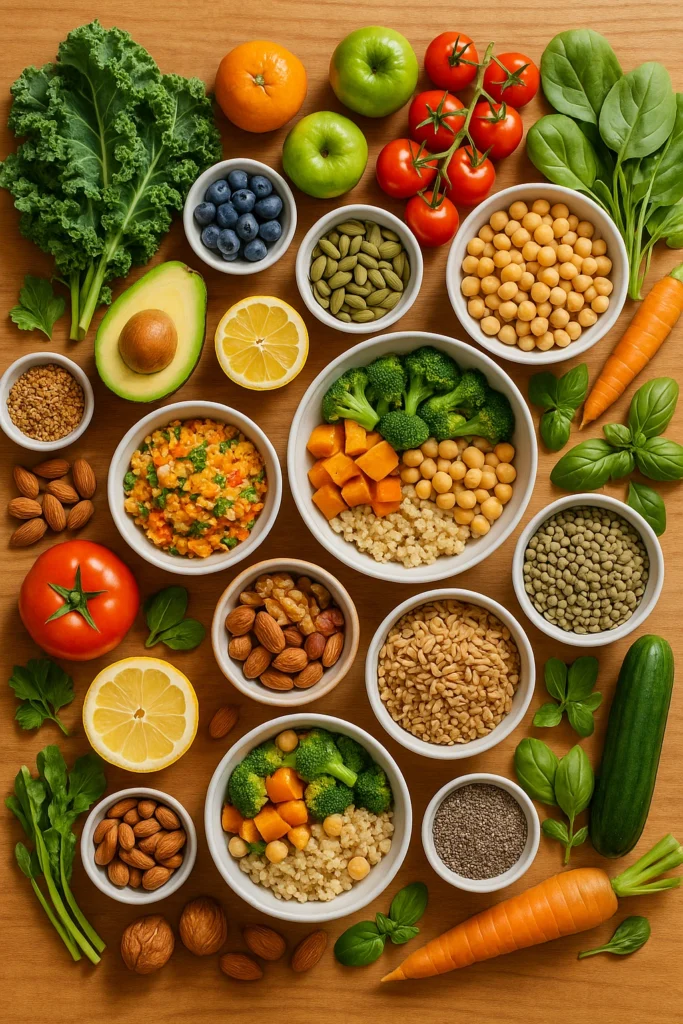
Many Christians use the Daniel Fast as a period of spiritual discipline. It typically includes:
- All fruits and vegetables
- Whole grains such as brown rice, oats, and barley
- Legumes such as lentils, chickpeas, and black beans
- Nuts and seeds
- Water and 100% fruit or vegetable juices
The Daniel Fast excludes meat, dairy, refined sugar, caffeine, and alcohol. It is usually practised for 21 days, based on Daniel 10:2-3.
Millions of Christians practise the Daniel Fast each year. It is one of the most popular faith-based fasting practices in the world today.
The Daniel Fast and Modern Research
A study published in Lipids in Health and Disease (Bloomer et al., 2010) examined 43 participants completing the Daniel Fast for 21 days. Researchers found significant improvements in:
- Total cholesterol (reduced by 19%)
- LDL (“bad”) cholesterol (reduced by 24%)
- Blood pressure (systolic and diastolic both improved)
- Markers of oxidative stress
These are significant results. They came after just 21 days. The study used no medication. Only food.
3. Your Body Is a Temple: The Theology of Stewardship
The Apostle Paul wrote one of the clearest calls to physical stewardship in all of Scripture. In 1 Corinthians 6:19-20,, he asks: “Do you not know that your bodies are temples of the Holy Spirit, who is in you, whom you have received from God? You are not your own; you were bought at a price. Therefore, honour God with your bodies” (NIV).
This is a profound truth. The body is not ours to abuse or neglect. It belongs to God. And we are called to honour Him with it.
Stewardship of the body includes what we put into it. The food we eat each day is an act of stewardship.
Self-Control as a Spiritual Discipline
Galatians 5:23 lists self-control as a fruit of the Holy Spirit. Many Christians apply this to speech or sexuality. But it also applies to food.
A plant-based diet requires thought and intention. It asks us to make deliberate choices. That is an act of self-control.
It also asks us to say no to comfort and convenience at times. That is an act of discipline. And discipline is a mark of spiritual maturity.
Creation Care and Christian Responsibility
Psalm 24:1 declares: “The earth is the Lord’s, and everything in it” (NIV). Christians are called to care for creation. This includes the food system.
Research from the University of Oxford shows that a plant-based diet produces up to 75% fewer greenhouse gas emissions than a meat-heavy diet (Scarborough et al., 2023, Nature Food). That is a meaningful way to care for God’s earth.
When Christians choose more plant foods, they practise creation stewardship in a very practical way.
4. What Does Science Say About a Plant-Based Diet?
The Bible provides the spiritual foundation. Science provides the supporting evidence. And the two align beautifully.
Reduced Risk of Chronic Disease
The Journal of the American Heart Association published a major review in 2019 showing that plant-based diets are associated with a 16% lower risk of cardiovascular disease and a 31% lower risk of cardiovascular mortality (Satija et al., 2019).
The World Health Organization (WHO) reports that non-communicable diseases such as heart disease and type 2 diabetes are the leading causes of death globally, responsible for 74% of all deaths. Diets rich in processed foods and animal products are key drivers.
Gut Health and Inflammation
A landmark 2022 study in Cell (Wastyk et al.) found that plant-rich, high-fibre diets increase microbiome diversity. A diverse gut microbiome is linked to lower inflammation, better immunity, and improved mental health.
The average adult needs 25 to 38 grams of fibre per day (Academy of Nutrition and Dietetics). Most people eat only about 15 grams. Whole plant foods are the richest source of dietary fibre.
Longevity and the Blue Zones
Researcher Dan Buettner identified five regions of the world called Blue Zones, where people live longest and healthiest. These include Sardinia (Italy), Okinawa (Japan), Nicoya (Costa Rica), Ikaria (Greece), and Loma Linda (California, USA).
Loma Linda’s longest-living population is largely Seventh-day Adventists. Their faith encourages a plant-based diet. Studies show they live on average 10 years longer than other Americans (Buettner & Skemp, 2016, American Journal of Lifestyle Medicine).
In every Blue Zone, plants form the foundation of the daily diet. Meat is eaten rarely, if at all.
5. Common Questions Christians Ask
Does eating a plant-based diet mean I can never eat meat?
No. The Bible does not forbid Christians from eating meat. Romans 14:2-3 makes clear that believers should not judge one another on matters of food. A plant-based diet is a health choice, not a moral law.
Many Christians choose to eat mostly plants and gradually reduce animal products. This is called a plant-forward or predominantly plant-based approach. It honours the body without imposing rules on others.
Is it expensive to eat plant-based as a Christian?
This is one of the most common concerns. And it is often a myth.
Dried legumes, lentils, oats, brown rice, sweet potatoes, and seasonal vegetables are among the most affordable foods in the world. These are also the foods with the strongest evidence for health benefits.
The Staple-First Method, taught through Zama Zincume’s plant-based resources, shows exactly how to eat abundantly on a limited budget. It begins with nutritious staples and builds meals from there.
What about protein?
This question comes up often. The good news is that plant foods contain plentiful protein. The Academy of Nutrition and Dietetics states that a well-planned plant-based diet meets all protein needs for every stage of life, including pregnancy, childhood, and old age.
Lentils, chickpeas, black beans, tofu, tempeh, pumpkin seeds, quinoa, and hemp seeds are all excellent plant protein sources.
Can I do the Daniel Fast long-term?
Yes, with some planning. The Daniel Fast is a short-term spiritual discipline for many. But its principles can guide long-term eating. A diet built on vegetables, legumes, whole grains, fruits, nuts, and seeds is one of the most studied and supported dietary patterns in the world.
6. How to Start a Christian Plant-Based Diet
Step 1: Pray First
Begin with prayer. Ask God to guide your food choices. Ask Him to help you see food as an act of worship. Invite the Holy Spirit into this area of your life.
Colossians 3:17 says: “And whatever you do, whether in word or deed, do it all in the name of the Lord Jesus” (NIV). That includes what you eat.
Step 2: Start with Plants You Already Love
Do not overhaul everything at once. Start small. Add one extra serving of vegetables to your dinner. Try a lentil soup on a weeknight. Swap white rice for brown rice.
Small changes, done consistently, create lasting habits. This is true in faith. It is also true in nutrition.
Step 3: Learn the Staple-First Method
The Staple-First Method builds your diet on affordable, nutrient-dense whole foods. It works in any country, on any budget. It is especially practical for families.
This approach was developed to help people eat abundantly and healthfully without spending more money. It draws on wisdom from traditional food cultures around the world, many of which ate predominantly plant-based long before it had a name.
Step 4: Use the Daniel Fast as a Reset
If you are new to plant-based eating, consider starting with the 21-day Daniel Fast. Use it as both a spiritual discipline and a physical reset. Many people are surprised by how well they feel by day 21.
Step 5: Build Community
Faith communities are powerful. If you are exploring a plant-based diet, share your journey with trusted friends or your church small group. Cook together. Share recipes. Encourage one another.
Ecclesiastes 4:9 reminds us: “Two are better than one” (NIV). This applies to health journeys too.
7. A Day of Plant-Based Eating Inspired by Scripture
Here is a simple, biblically inspired plant-based day of eating. All of these foods appear directly or indirectly in Scripture.
Breakfast
- Oat porridge with honey, figs, and walnuts (Proverbs 24:13; Deuteronomy 8:8)
- Herbal tea or water
Lunch
- Red lentil soup with olive oil and herbs (Lentils: Genesis 25:34)
- Whole grain flatbread (Leviticus 2:1)
- Sliced cucumber and olives
Dinner
- Chickpea stew with spinach and tomatoes (Ezekiel 4:9 grain bowl variation)
- Brown rice or barley
- Pomegranate seeds for dessert (Song of Solomon 4:13)
This is not a rigid plan. It is a simple picture of what it looks like to eat plants with intention, with pleasure, and with gratitude to God.
8. Recommended Resources from Zama Zincume
If you want to go deeper, Zama Zincume’s books and course give you everything you need to start a plant-based lifestyle that is practical, affordable, and rooted in good health.
Books Available on Amazon
- Affordable Plant-Based Eating in South Africa — The Staple-First Method in a practical, accessible guide. Perfect for beginners and families on any budget.
Online Course
The Plant-Based Budget Blueprint course walks you through 7 modules covering nutrition foundations, meal planning, shopping strategies, and the Staple-First Method in action. Available at EatingPlantBasedZA.com.
These resources are designed to help you build a sustainable plant-based lifestyle. They are practical, evidence-based, and created with Christian values of stewardship and simplicity in mind.
Frequently Asked Questions
What is a Christian plant-based diet?
A Christian plant-based diet centres on whole plant foods such as vegetables, fruits, legumes, and grains. It is inspired by Genesis 1:29, the Daniel Fast, and the biblical call to honour God with your body.
Is a plant-based diet biblical?
Yes. The first diet described in Scripture is plant-based (Genesis 1:29). The Daniel Fast is a plant-based practice recorded in the Old Testament. Many biblical foods, including lentils, olives, figs, and grains, are whole plant foods.
What is the Daniel Fast?
The Daniel Fast is a 21-day plant-based eating practice based on Daniel 1 and Daniel 10. It includes vegetables, fruits, whole grains, legumes, nuts, seeds, and water. It excludes meat, dairy, sugar, caffeine, and alcohol.
Can Christians eat meat?
Yes. The Bible permits Christians to eat meat (Genesis 9:3; Romans 14). A plant-based diet is a health and stewardship choice, not a religious law. Many Christians choose to eat mostly plants and reduce meat gradually.
What are the health benefits of a plant-based diet?
Research shows plant-based diets are linked to a lower risk of heart disease, type 2 diabetes, certain cancers, and obesity. They are also associated with better gut health, reduced inflammation, and longer life.
External References and Further Reading
The following reputable sources support the claims in this article. All links open in a new tab.
- Bloomer et al. (2010) — Daniel Fast Study, Lipids in Health and Disease — Primary source for the 21-day Daniel Fast clinical trial.
- Satija et al. (2019) — Plant-Based Diets and Cardiovascular Risk, JAHA — Peer-reviewed data on plant-based diets and heart disease risk.
- Scarborough et al. (2023) — Dietary Greenhouse Gas Emissions, Nature Food — Oxford University research on diet and climate impact.
- Buettner & Skemp (2016) — Blue Zones and Longevity, AJLM — Research on plant-forward diets in the world’s longest-living populations.
- Academy of Nutrition and Dietetics — Plant-Based Diets Position Paper — Professional dietitian position on plant-based nutrition adequacy.
- World Health Organization — Noncommunicable Diseases — Global data on chronic disease burden and dietary risk factors.
Conclusion: Eating to Honour God
A Christian plant-based diet is not a trend. It is a return to something ancient.
The diet honours the God who designed the body. It follows the example of Daniel. It practises the stewardship Paul calls every believer to embrace.
And it works. The science shows it. The Bible shows it. The bodies of people who have tried it show it.
You do not have to change everything at once. Start with one meal. Try the Daniel Fast for a week. Add one more vegetable to your plate tonight.
God honours faithful small steps.
| READY TO START? Explore Zama Zincume’s plant-based books and the Plant-Based Budget Blueprint course at EatingPlantBasedZA.com. Learn the Staple-First Method and discover how to eat abundantly, affordably, and in a way that honours God. Visit: https://eatingplantbasedza.com |
Share this article with a friend, a small group, or your church community. Good food is even better when it is shared.

One Response